
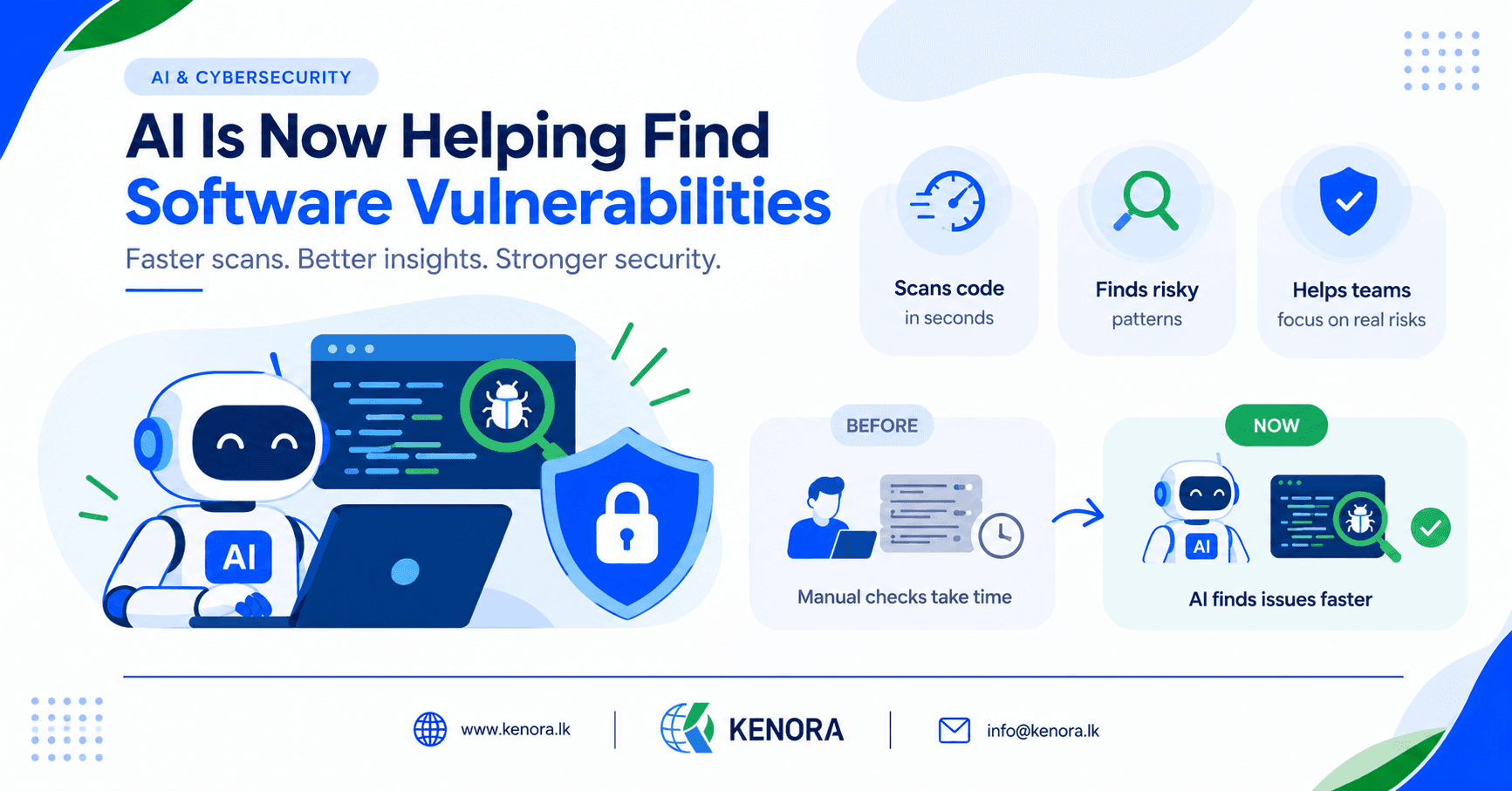
AI Is Now Helping Find Software Vulnerabilities
Cybersecurity has always been a race. Security teams look for weaknesses before attackers can find them. They test websites, apps, networks, and systems to keep everything safe.
Now something is changing. AI has joined that race.
Instead of checking every possible problem by hand, security teams can use AI to scan huge amounts of code, spot unusual patterns, and flag areas that need a closer look.
This doesn't mean AI will replace cybersecurity experts. It means these experts now have a much faster tool to work with, and that matters more as software keeps getting more complex.
Finding a Weakness Is Not Easy
A modern app can have thousands, even millions, of lines of code. Behind one simple website there could be:
- APIs
- Databases
- Cloud services
- Third-party tools
- Login systems
- Payment systems
- Mobile apps
Each of these pieces can create a security risk. One small coding mistake can turn into a serious problem, and the hard part is finding that mistake before someone else does.
Traditional security testing is still valuable, but it takes time. Researchers have to check systems, understand how they work, test possible attack paths, and figure out whether a finding is actually dangerous. AI can speed up parts of this work.
How AI Can Help
Think of AI as another member of the security team. It can scan far more code than a person ever could, look for patterns that hint at problems, and connect pieces of information to point researchers toward the areas that need a closer look.
Google, for example, uses an AI system called Big Sleep to hunt for software vulnerabilities, and its CodeMender project focuses on fixing security issues automatically.
Finding a vulnerability early gives a company more time to fix it, and that's really the whole goal: find the problem before an attacker does.
AI Can Look Where Humans Might Miss
People are good at understanding context and making judgment calls, but people also get tired, and they can miss small details buried in mountains of information.
AI doesn't get tired the same way. It can keep checking code and hunting for patterns across an entire system without losing focus.
That doesn't mean AI is always right, though. It can flag something that isn't really a problem, and it can miss something an experienced researcher would catch right away. That's why human review still matters. The best setup isn't AI instead of people, it's AI working alongside them.
The Race Is Getting Faster
Here's the catch: security teams aren't the only ones using AI. Attackers are using it too.
Google reported in 2026 that some threat actors were using AI to help discover vulnerabilities and build exploits. In one case, Google said it found high confidence evidence that an AI model helped attackers build a working zero-day exploit that could bypass two-factor authentication on a widely used system administration tool.
That changes things. If attackers can find and use security weaknesses faster, businesses have less time to react. A vulnerability that goes unnoticed for months can turn into a much bigger problem the moment attackers find it first. Old security habits aren't enough anymore.
More Vulnerabilities Also Mean More Work
There's another problem that doesn't get talked about enough: what happens when AI finds too many vulnerabilities?
Finding problems faster sounds great, until a security team suddenly gets hundreds of alerts at once. Which one should they fix first? A small issue that barely matters? Or a weakness that could let someone reach sensitive customer data?
This is where good judgment comes in. The goal isn't to fix every alert at the same time, it's to understand the real risk and focus on what matters most. Recent reporting shows AI is speeding up vulnerability discovery, but many businesses still struggle to validate, prioritize, and actually fix everything that gets found.
Finding a Vulnerability Is Only the Beginning
This might be the most important point in the whole article. Finding a vulnerability doesn't make a system secure. It's only step one.
A solid security process usually looks like this:
Find → Understand → Prioritize → Fix → Test Again
Say a security test turns up a weakness in a company's login system. The team needs to figure out how serious it really is. Can someone get into another user's account? Can private information be exposed? Can the issue be reproduced? What caused it, and how can it be fixed without breaking the app?
Once it's fixed, the system needs to be tested again. This is exactly where experienced security teams earn their keep.
What Should Businesses Do?
Businesses don't need to start using AI for everything tomorrow, but they should understand how security is changing.
A good starting point is regular security testing: vulnerability scans, penetration tests, application testing, and routine reviews of systems and software. Keep software updated, and don't let important vulnerabilities sit ignored.
Most of all, security shouldn't be something that only gets attention after an attack happens. It should be part of the process from day one, built in from the start of development, not bolted on afterward.
AI Is Another Layer of Defense
AI won't magically make cybersecurity easy. There will always be new vulnerabilities, new attack methods, and new technology to protect.
But AI gives security teams something valuable: speed. It helps them search faster, investigate faster, and respond faster, and when attackers are using AI too, that speed matters more than ever.
The future of cybersecurity probably isn't humans versus AI. It's security teams using AI to stay ahead of attackers who are doing the same thing. That race has already begun.
For businesses, the takeaway is simple: don't wait for someone else to find the weakness in your system. Find it first. Fix it. Then test again. That's how technology gets safer, not just smarter.