
How Quantum-Safe Security Could Protect Business Data
Picture this. Your company keeps customer records, bank details, and next year's business plans online. Right now, encryption keeps all of that private. But what if the computers of the future could break the locks we use today?
That is the question more and more businesses are starting to ask.
Quantum computing could do great things for science and technology. It could also create new problems for digital security. That is why experts are building a new kind of protection called quantum-safe security.
It may sound like something for the distant future. But businesses that start thinking about it early will be in a much better place.
What Is Quantum-Safe Security?
Every day, businesses send emails, share files, take payments, and store private information. Encryption protects all of this. It scrambles your data so nobody can read it without the right key.
Today's encryption works well against the computers we use now. A powerful quantum computer, though, might one day break some of the methods we rely on. Quantum-safe security is about getting ready for that day.
A big part of it is called post-quantum cryptography. These are new security methods built to stay strong even against quantum computers. The best part is that they run on normal computers. You do not need to buy any quantum technology to start preparing.
This is not just a theory either. In 2024, NIST, the US standards body, released its first finished standards for post-quantum encryption. The tools are real, and they are starting to arrive in everyday software.
Why Should Businesses Care Now?
You might be thinking, quantum computers are still being built, so why worry today?
Because some information needs to stay private for a very long time.
Think about a hospital that stores patient records. Or a finance company with years of transaction history. Or a tech business with product designs that took years to create. Even if this data is safe today, it could still be valuable to an attacker ten or twenty years from now.
That brings us to a risk called harvest now, decrypt later.
Here is how it works. Someone steals or copies encrypted data today. They cannot read it yet, so they simply store it. Years later, if quantum computers become powerful enough, they try to unlock it. That means data stolen today could be exposed years from now.
To be fair, not every business faces the same level of risk, and today's quantum computers cannot break modern encryption at scale. But changing security systems takes a long time. If your business handles information that must stay private for years, it is smart to understand your risks now.
How Could Quantum-Safe Security Help?
Quantum-safe security is not a magic product that fixes every security problem. Think of it as a set of methods that help you get ready for changes in encryption. Here are three areas where it can make a difference.
1. Protecting Customer and Business Data
Companies hold a lot of valuable information, from customer details to financial records and internal files. If any of it must stay private for many years, future encryption risks deserve your attention.
Quantum-safe methods help you prepare your systems to protect this data against future quantum attacks. A good first step is simple. Find out which data matters most and how it is protected today.
2. Making Online Systems More Secure
Your team logs in to company systems. Your customers visit your website. Your staff share files between offices. Most of these things rely on encryption.
As quantum-safe standards arrive in business software, cloud services, and networks, some of these connections will need updates. Ask your technology providers about their plans for post-quantum security. This helps you get ready without rushing into changes too early.
3. Protecting Important Business Secrets
Customer data is not the only thing worth protecting. Your company may also hold product designs, research, source code, future plans, and trade secrets. If these leak, the damage can last for years.
Quantum-safe security can be one part of a long-term plan to protect these assets. Start by listing the information that would hurt the most if it became public. That tells you which systems need attention first.
What Can Businesses Do to Prepare?
You do not need to replace every system tomorrow. A few practical steps are enough to get started.
1. Check where encryption is used
Look at the systems that protect your websites, apps, databases, emails, and business messages. You cannot plan updates until you know where encryption lives.
2. Find your most sensitive information
Focus on data that must stay private for many years. Medical records, financial data, research, and business secrets are common examples.
3. Talk to your technology providers
Ask your software vendors and cloud providers about post-quantum security. Do their products support the new standards? If not, do they have a clear plan to do so?
4. Review older systems
Old apps and devices can be hard to update. Spotting them early gives your team time to plan and helps you avoid nasty surprises.
5. Make a simple plan
Start with the systems that protect your most valuable data. Then plan the rest based on risk, cost, and business needs.
Not sure what to protect first? This table shows one simple way to think about it.
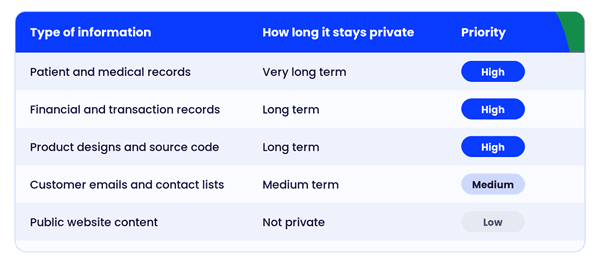
These steps help you get ready for the future while you keep protecting against today's threats.
Will Quantum-Safe Security Replace Cybersecurity?
No. It is only one part of a complete security plan.
You will still need strong passwords, access controls, regular software updates, safe backups, staff training, and security testing. Post-quantum cryptography deals with the risks quantum computers may bring to certain encryption and digital signature methods. It will not stop phishing, ransomware, or stolen passwords on its own.
Think of it as upgrading one important lock on your door. You still need the rest of the door, the walls, and the alarm. A good plan protects you from today's threats while getting you ready for tomorrow's.
Preparing Today for Tomorrow's Risks
Encryption is built into almost everything. Websites, business apps, cloud services, and connected devices all use it. That is why updates take time. Teams need to check compatibility, test changes, and make sure daily work keeps running smoothly.
So quantum-safe security is not something to leave until the last minute. Companies that understand their systems today will make better decisions when updates become necessary.
At Kenora, we believe good technology planning means looking past today's problems. Whether a business is improving its software, managing its data, moving to the cloud, or strengthening its cybersecurity, getting ready for change leads to more reliable systems.
The future of cybersecurity is not only about stopping attacks today. It is also about protecting the information we need to keep safe tomorrow.