
Microsoft’s New AI Chip: Why Custom Chips Matter
Every time you ask an AI tool a question, a powerful chip does the hard work behind the scenes. It reads your request, runs a huge number of calculations, and sends back an answer in seconds.
That work is not cheap. It needs computing power, memory, and a lot of electricity.
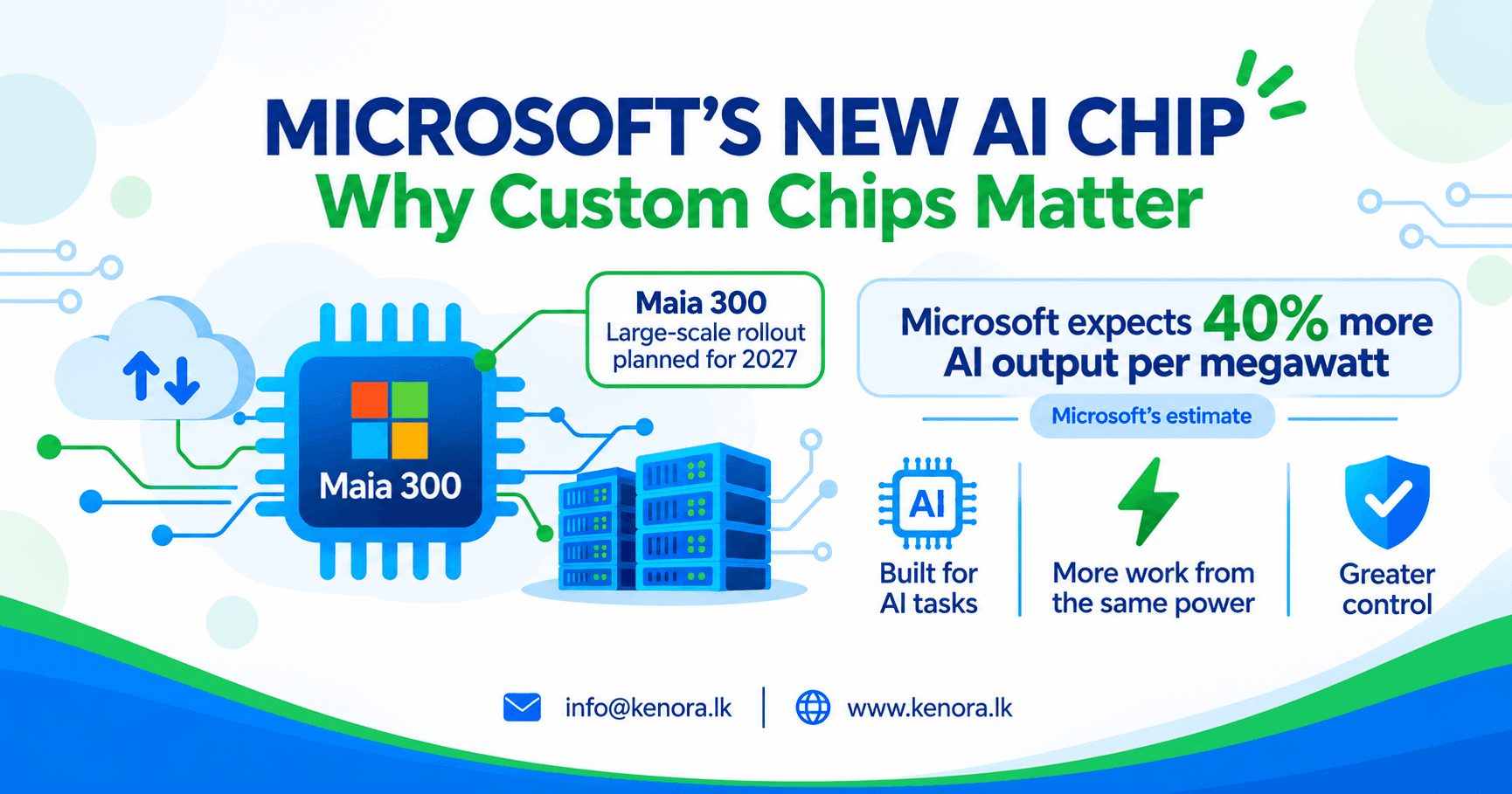
On October 12, 2026, Microsoft announced a new chip to help with this problem. It is called Maia 300, and Microsoft plans to start large scale rollouts in 2027.
It is more than a new piece of hardware. It shows how big tech companies are building their own chips to keep up with AI. So why do custom AI chips matter, and what could they mean for your business?
What Is the Maia 300 Chip?
Think of an AI chip as the engine inside an AI service. It does the calculations that help AI understand a request and write a reply.
Maia 300 is the third generation of Microsoft’s own AI chips. It is built to run inside Microsoft’s data centers. Microsoft says it will become the main system behind AI in its products, including Copilot.
Its big focus is AI inference. Here is an easy way to see it. Training is like going to school, where an AI model learns from lots of data. Inference is like going to work, where the model uses what it learned to answer your question.
Training happens before a model is released. Inference happens every time someone uses it. As more people use AI, companies need hardware that can answer more requests without wasting time or power.
That is the idea behind a custom chip. You build the hardware around the job it needs to do.
Why Do Companies Build Their Own AI Chips?
For years, most heavy computing ran on general purpose processors and graphics processing units, or GPUs. These chips are still very important. But AI is growing so fast that big companies want more options. Here are three reasons.
1. Better Speed for Specific Jobs
Not every AI job is the same. Training a model and answering a question from an existing model put different demands on hardware.
A custom chip can focus on the work a company does most. Maia 300 is built mainly for inference, so Microsoft can match the hardware to the job. Microsoft says it is designed for long conversations, reasoning, and AI agents that handle tasks with many steps.
2. Smarter Use of Electricity
AI data centers use huge amounts of power. Electricity runs the chips, moves the data, and keeps everything cool.
Microsoft expects Maia 300 to produce 40% more tokens per megawatt than leading GPU systems. A token is a small piece of text that an AI reads or writes, so more tokens means more AI work from the same power.
This is Microsoft’s own claim. Real results can change depending on the workload and the setup. The goal is simple: get more useful work from the power you have.
3. More Control Over Technology
Companies that rely only on outside suppliers can run into problems with supply, price, and availability. Building their own chips gives them more control over how their AI systems are designed and improved. It also lets hardware and software teams work together from day one.
But custom chips do not remove the need for partners. Microsoft still needs outside help to manufacture its chips, and reports say Maia 300 uses technology from TSMC.
How Could Maia 300 Improve AI Services?
Picture someone asking an AI assistant to explain a document, fix some code, or answer a hard question. The system needs computing power to understand the request and write a reply. Now picture millions of people doing that at the same time. Even small gains start to matter.
Microsoft says a Maia 300 rack could produce up to seven times the tokens of a Maia 200 rack. Each rack is also planned to hold 96 chips, about twice as many as before. Here is a quick look at how the two chips compare.
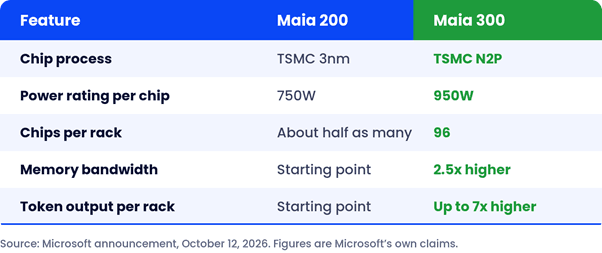
These numbers come from Microsoft’s announcement. They are goals and company claims, not a promise for every task. News reports also noted that no outside company had tested Maia 300 when it was announced.
If the gains hold up, Microsoft could handle more AI requests with the same data center space. That could help services like Copilot keep up as demand grows. Still, a chip alone cannot make an AI service better. Software, memory, networks, and the design of the data center matter too.
Will Other AI Chips Disappear?
No. Building a custom chip does not mean a company stops using other hardware. Microsoft still works with companies like Nvidia and AMD, and Google and Amazon have their own AI chips too.
Different AI jobs need different tools. Some run well on custom chips. Others work better on GPUs. Using a mix gives companies room to pick the right tool for each job, instead of asking one chip to do everything.
The future of AI will likely depend on how well chips, software, and systems work together.
What Does This Mean for Your Business?
You may be wondering why you should care about a chip you will probably never buy. Fair question. The answer is that the hardware behind AI shapes the AI tools you use every day.
AI tools may get more efficient. If cloud providers run AI more efficiently, they can serve more people and bigger workloads. But that does not mean lower prices for you.
Cloud services will keep changing. If you use AI through a cloud platform, you never touch the chips. But better technology behind the scenes can affect how fast and how available those services are.
Picking the right AI tool still matters. A new chip is exciting, but your business should ask if the tool is useful, safe, reliable, and fairly priced. For example, a team that uses AI to process documents cares about speed, accuracy, and cost, not chip details.
Knowing the real business benefits is worth more than following every hardware announcement.
The Challenges of Custom AI Chips
Custom chips are hard to build. They take time, special skills, and a lot of money. The chip also has to work well with the software, memory, networks, and data centers around it.
AI changes fast, too. Companies must make sure their hardware stays useful as new models and workloads appear.
And performance claims need real testing. Announced numbers are a good start, but what matters is how the chip performs in daily use.
For Microsoft, Maia 300 is a long term bet on its AI setup. Its success will depend on how well the company builds, rolls out, and uses it.
Final Thoughts
Maia 300 shows where the AI industry is heading. Companies are not only building better AI models. They are also improving the hardware that runs them.
Custom chips can boost performance, save power, and give companies more control. They also come with challenges and need careful testing.
For businesses, the takeaway is simple. You do not need to know every technical detail to benefit. Focus on how AI tools can improve your work, save time, and help you reach your goals.
The future of AI will depend not only on smarter software, but also on the technology that powers it.